
The main performers of the laboratory
Head of the laboratory:
- Sazhin Sergey Stepanovich, Professor, Fellow of the Institute of Physics (Great Britain)
Responsible persons:
- Vladimir V. Terekhov, Dr. Sci. (Phys.-Math.), Professor of the RAS
- Leonid M. Chikishev, PhD (Phys.-Math.)
Key members of the team:
- Dmitry V. Antonov, PhD (Phys.-Math.)
- Artur V. Bilsky, PhD (Phys.-Math.)
- Vladimir M. Dulin, Dr. Sci. (Phys.-Math.), Professor of the RAS
- Geniy V. Kuznetsov, Dr. Sci. (Phys.-Math.), Professor
- Alexander N. Pavlenko, Dr. Sci. (Phys.-Math.), Corresponding Member of the RAS
- Maxim A. Pakhomov, Dr. Sci. (Phys.-Math.), Professor of the RAS
- Sergey V. Starinskiy, Dr. Sci. (Phys.-Math.)
- Pavel A. Strizhak, Dr. Sci. (Phys.-Math.), Corresponding Member of the RAS
- Viktor I. Terekhov, Dr. Sci. (Eng.), Professor
Objectives of the laboratory
Addressing pressing issues in multiphase hydrodynamics and thermal physics of multiphase systems at world-class levels, involving large-scale fundamental research aimed at developing new technologies:
Project objectives
Development of experimental setups capable of spraying (at the mile, micro, and nanoscale) purified liquids containing solid and liquid soluble and insoluble impurities (using solutions, emulsions, and suspensions as examples) using various injection patterns and under conditions similar to flow chambers and closed systems.
Development of physical and mathematical models of single droplets, small groups, and large aggregates, with subsequent transition to sprays and aerosols, to account for synergistic (collective, cascade) effects. Application of proprietary codes, commercial packages, and combined models based on numerical and analytical solutions.

Development of a generalized scientific theory of interconnected physicochemical processes, taking into account phase transformations, to predict the conditions for intensive thermal water purification from impurities. Mathematical processing of experimental results. Their generalization using dimensional and dimensionless complexes.

Developing recommendations for the practical application of research results, preparing prototypes of spray devices, mixing reactors, evaporation systems, and technology concepts, patenting technical solutions for methods and devices, and registering computer programs with key software codes.
Creating components (nozzles, mixing devices, regrinders, and hardware and software modules) for adaptive multiphase precision spray systems for contaminated liquids in the form of solutions, emulsions, and suspensions.
Experimental and theoretical studies of the behavior of jet-droplet flows propagating to the surface from single and multi-nozzle sources; experimental and theoretical studies of the interaction processes between jet-droplet flows and heated smooth and modified surfaces, determining maximum heat transfer; identifying, including using artificial intelligence based on neural networks, the optimal structure of micro- and macromodified layers on a heat-loaded surface to increase the critical heat flux.
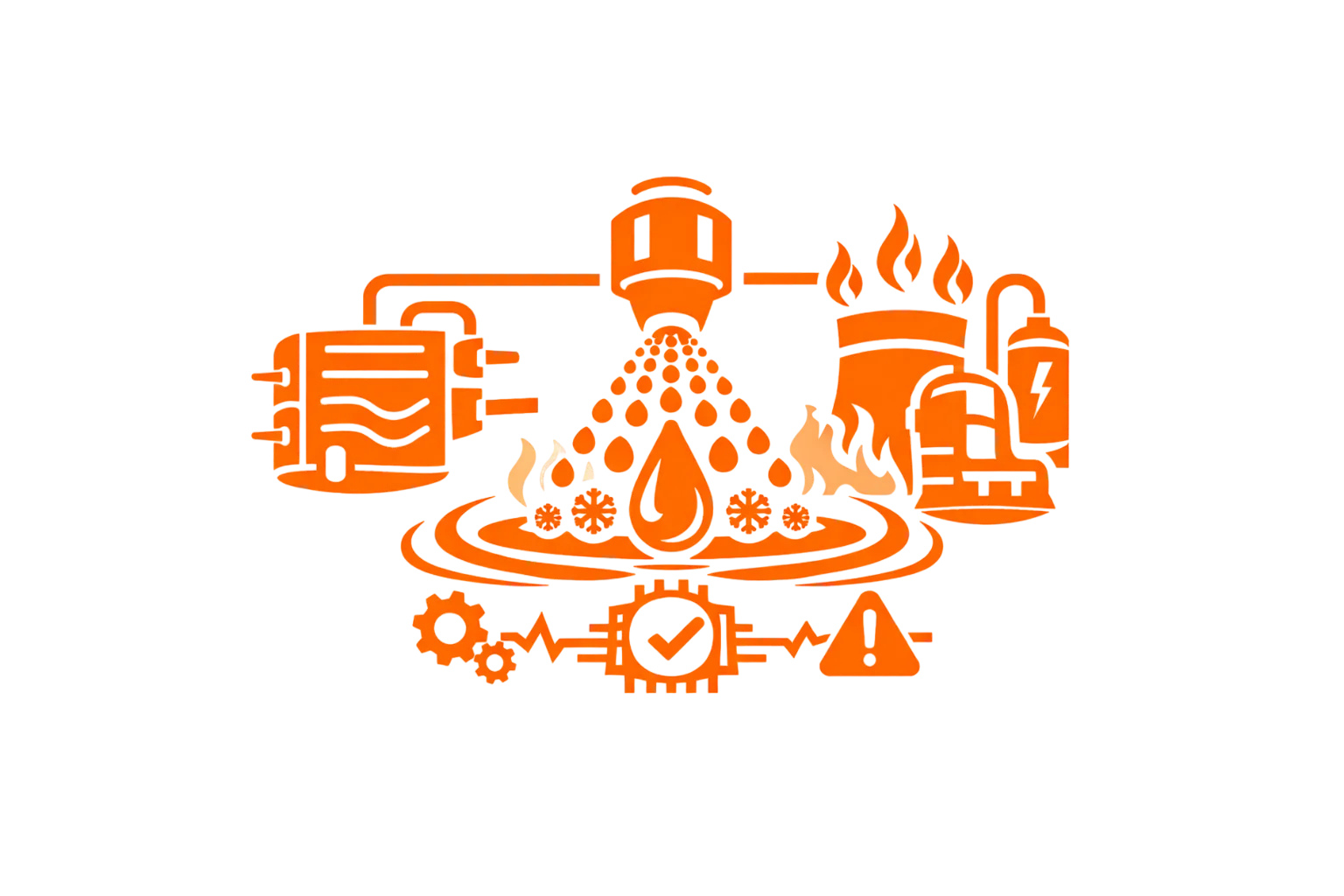
Development of efficient cooling systems based on jet-spray irrigation of heat-loaded process surface models to maintain normal operating conditions and prevent accidents in industrial systems containing elements that generate excess heat.
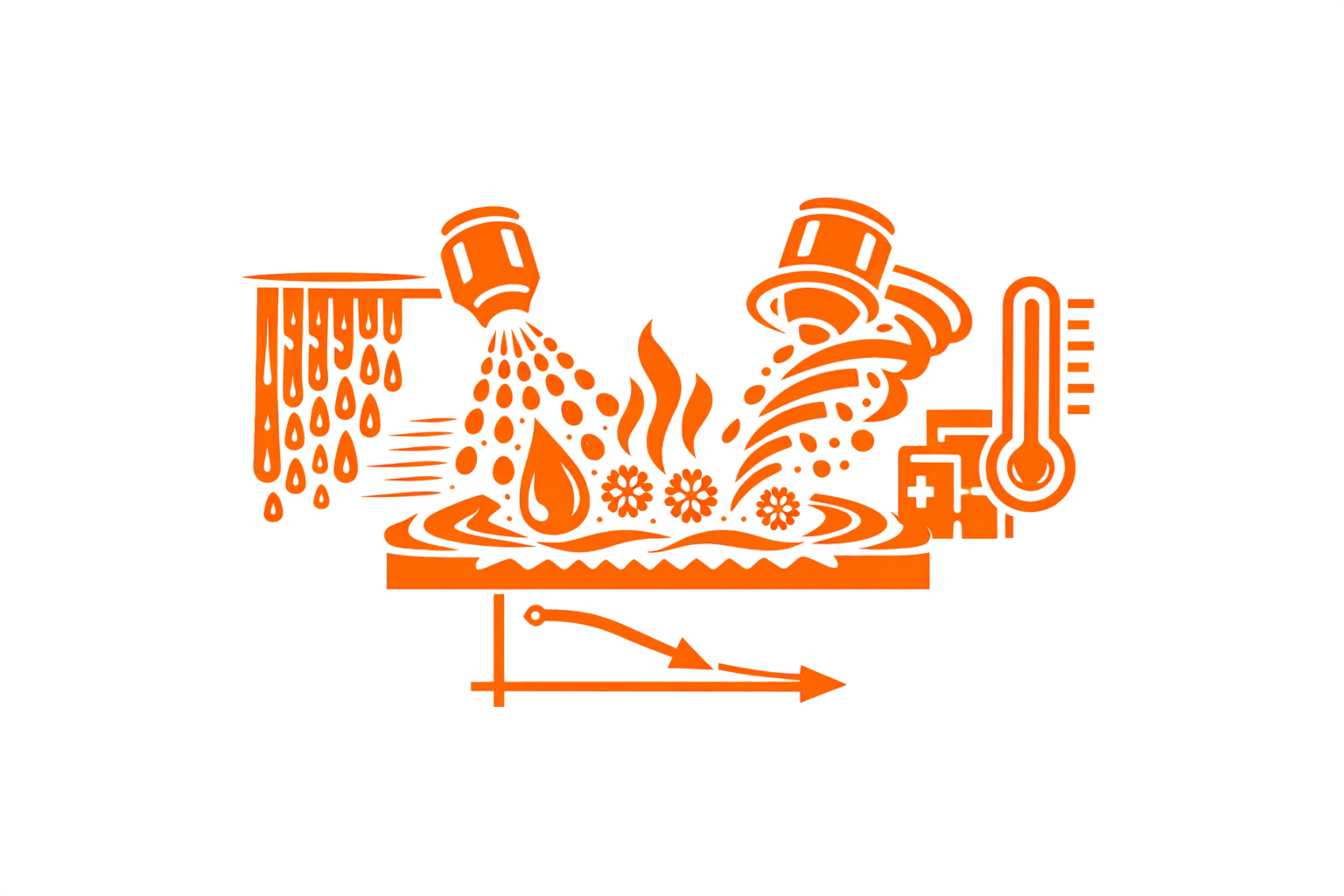
Development of efficient methods for cooling heat-stressed surfaces using non-swirling and vortex wall-mounted gas-droplet jets (gas-droplet curtains).
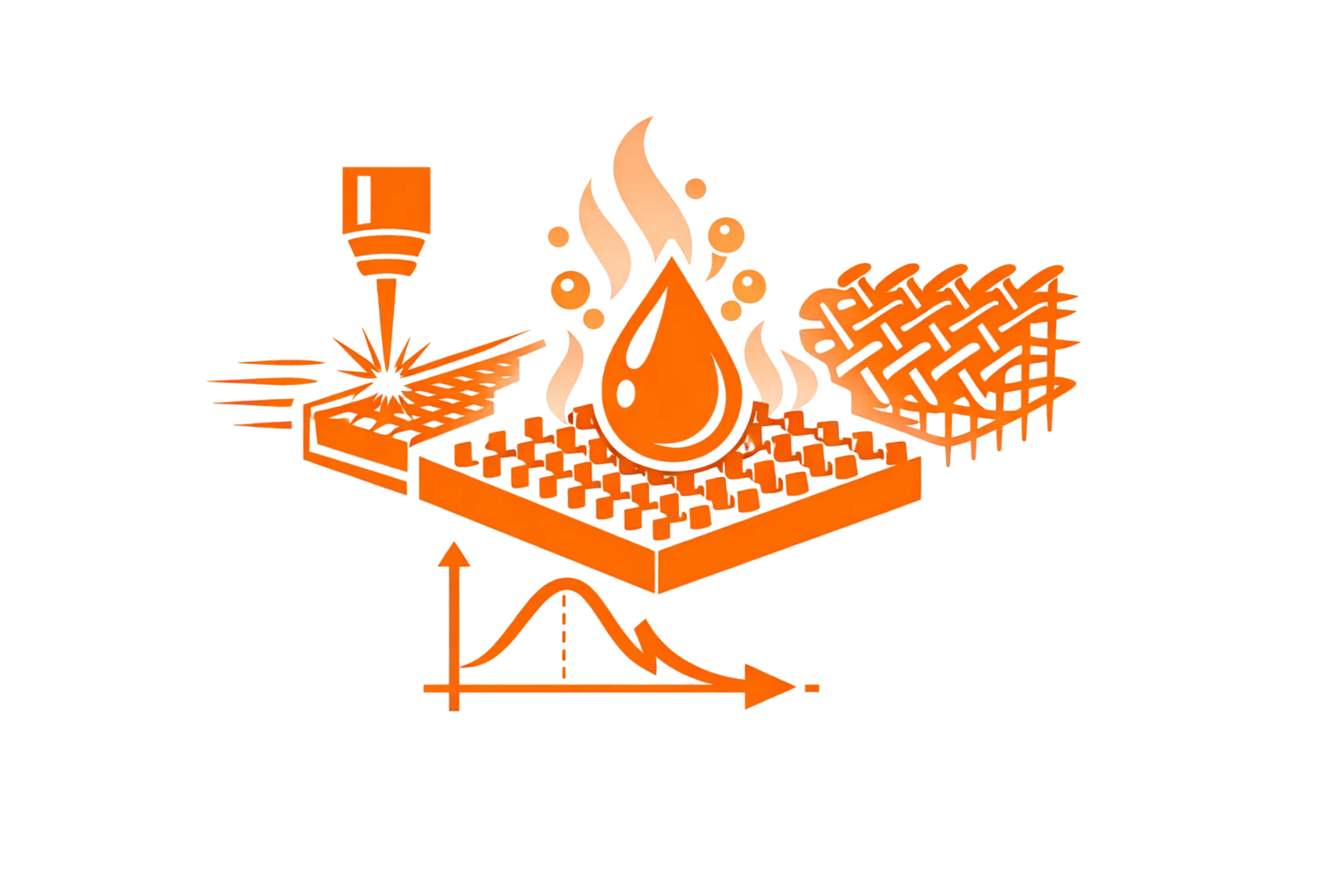
A comprehensive study of heat transfer processes and critical phenomena during the boiling and evaporation of promising dielectric liquids on microstructured heat-transfer surfaces created both by selective laser melting/sintering (SLM/SLS), more commonly known as 3D printing, and on heat-transfer surfaces with mesh coatings.

The problem of describing secondary liquid dispersion processes. The complexity of secondary dispersion processes is explained by the diversity of phenomena that occur under conditions of velocity and/or thermal nonequilibrium between the droplet and the gas flow, such as droplet deformation, internal liquid motion, and viscous and capillary effects.

Determination of critical flow parameters of multiphase flows formed by the co-spraying of immiscible liquids using non-contact optical diagnostic methods for determining the velocity components of the dispersed and carrier phases, the size, shape, and position of individual particles, and particle distribution in the flow.

Development of methods for controlling active matter, including magnetic active materials. Analysis of collective phenomena during droplet motion in emulsions on smooth and porous surfaces, including during chemical reactions.
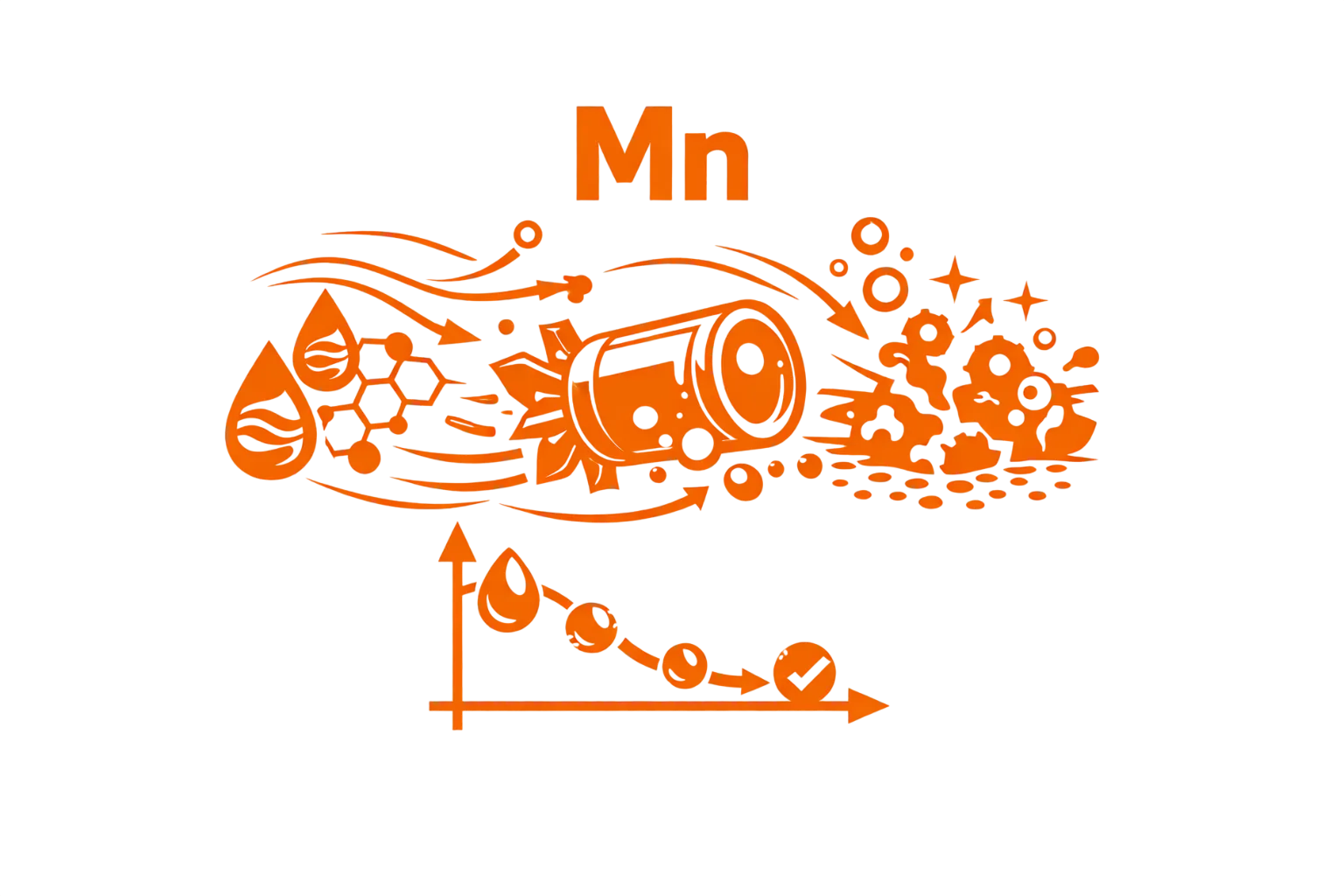
Creation of manganese-based catalytic micromotors for removing organic dyes from wastewater.
Planned results of the project

Predictive mathematical models of heat and mass transfer and hydrodynamics for complex liquids (solutions, suspensions, emulsions, including those with bacteriological impurities).
Dimensional and dimensionless maps of the behavioral regimes of liquid droplets with complex component compositions in the form of solutions, suspensions, and emulsions, including those with bacteriological impurities.
Components (e.g., nozzles, mixing devices, regrinders, software modules) of adaptive multiphase precision spray systems for contaminated liquids in the form of solutions, emulsions, and suspensions.
An adaptive system for selecting the most effective water purification method for impurities will be developed, taking into account multi-criteria analysis across all key categories (e.g., economics, energy, processability, duration).
Optimized technology for thermal liquid purification: evaporative and thermal-oxidative (evaporation and oxidation in a flame or flow of heated gases with the required component composition to intensify certain reactions that allow the separation of mineralized impurities and bacteria) by varying spray parameters, heat exchange, and hydrodynamics.
Optimal modes for pulsed single-phase and two-phase cooling of large surfaces using heat transfer enhancement methods, such as the use of mixtures and various additives in the base fluid as working fluids, and surface modification using pulsed laser radiation.
Fundamental results on the efficient cooling of heat-loaded surfaces of power machines and equipment using gas-droplet wall curtains utilizing the swirling effect.
Final recommendations for the effective use of microstructured capillary-porous coatings created by 3D printing and mesh coatings (including those with additional micro-modification of their surface) to intensify heat transfer and increase the critical heat flux during boiling and evaporation of promising dielectric fluids in horizontal layers with varying layer thicknesses and reduced pressures.
Scientific foundations for describing the patterns of active matter motion, including an analysis of the collective and transport properties of an active emulsion during chemical reactions in the system, the motion of magnetic nanoparticles through the liquid-liquid interface, active objects containing paramagnetic and ferromagnetic materials, and methods for synthesizing manganese-based micromotors using the plasma-arc method.
A promising technology for the co-spraying of immiscible liquids. Unique experimental data will be obtained on the spatial distribution of dispersed phase velocity depending on the operating parameters of gas-liquid turbulent flow, the type and composition of immiscible liquids, and the size distribution of multicomponent droplets.
Software modules and applications for modeling the processes of heating, evaporation, atomization, and secondary grinding of purified water containing impurities.
Educational program on thermal liquid purification.
Test rigs for studying various methods of thermal liquid purification.